15 Small Kitchen Organisation Ideas That Actually Work
If your kitchen feels like it’s bursting at the seams, you’re not alone. Most of us are working with the same few cabinets, one stretch of counter, and a junk drawer that seems to multiply on its own. The good news is that a small kitchen doesn’t need a remodel — it needs a system. These small kitchen organisation ideas are the ones that actually work in real kitchens: no fancy renovations, no expensive gadgets, just smart storage, honest decluttering, and a few habits that keep things tidy long after the first burst of motivation fades. Most of these ideas cost under $20 and take less than an hour to set up. Pick three or four that fit your kitchen, start there, and build from there.
Start With a Kitchen Reset (Before You Buy Anything)
1. Declutter ruthlessly first
Before you buy a single bin or basket, take everything out of one cabinet or drawer and be honest about what’s in there. Toss expired food, donate the bread maker you haven’t touched since 2023, and say goodbye to the third vegetable peeler. The rule that works best: if you haven’t used it in a year and it isn’t seasonal (like the turkey roaster), it goes. Most small kitchens aren’t short on space — they’re full of stuff nobody uses. Decluttering first means every storage solution you add afterwards actually has room to work.
2. Group like with like
Kitchens feel chaotic when the same category of item lives in five different places. Pull your baking supplies into one spot, your coffee and tea into another, and your everyday dishes near the dishwasher so unloading takes two minutes instead of ten. Think in zones: a cooking zone by the stove (oils, spices, utensils), a prep zone by the biggest stretch of counter (cutting boards, knives), and a clean-up zone by the sink (dish soap, towels, trash bags). When everything has a home, putting things away becomes automatic — and so does finding them.
3. Try the one-in, one-out rule
Small kitchens stay organised only if the amount of stuff stays level. The one-in, one-out rule is simple: every time something new comes into the kitchen, something old leaves. New coffee mug? An old one goes to the donation box. New gadget? The one it replaces gets passed on. It takes five seconds and it stops the slow creep that undoes all your hard work. Families who stick with this rule find their kitchens stay tidy for months instead of days.
Small Kitchen Organisation Ideas for Cabinets and Drawers
4. Add shelf risers inside cabinets
Cabinet shelves are almost always taller than the things sitting on them, which means you’re wasting the top half of every shelf. A simple stackable shelf riser — usually $10 to $15 at Walmart, Target, or Amazon — instantly doubles the usable space for plates, bowls, and mugs. Put one in the cabinet where you keep everyday dishes and you’ll stop stacking bowls three high and hoping for the best. They come in white, bamboo, and metal finishes, so you can match your kitchen without thinking too hard about it.
5. Use turntables in deep cabinets
Deep cabinets are where food goes to be forgotten. A turntable (the lazy Susan your grandma had, now in a much prettier version) fixes that in one move. Spin it and you can see everything — no more buying a third jar of cumin because the first two were hiding at the back. They work best for oils, vinegars, sauces, and spices. Look for ones with a non-slip surface and a low lip so bottles don’t slide off when you spin. A 10-inch turntable fits most standard cabinets and costs around $8 to $12.
6. Put dividers in every drawer
Drawers without dividers become junk drawers — it’s practically a law of nature. Adjustable bamboo dividers cost about $15 for a set and turn a messy utensil drawer into something that actually makes sense. Give every category its own slot: spatulas together, measuring cups together, and the random batteries and twist ties in their own little section (every kitchen has them). The real win is maintenance: when a drawer has clear sections, everyone in the family puts things back in the right place without being asked.
7. Hang storage on cabinet doors
The inside of a cabinet door is free real estate most people never use. Over-the-door racks and adhesive hooks can hold cutting boards, pot lids, foil and plastic wrap, cleaning supplies, and measuring cups — all the flat, awkward things that eat drawer space. Under-sink cabinet doors are perfect for spray bottles and sponges. Use damage-free adhesive hooks if you’re renting, or screw-in racks if you own. Either way, you’re adding storage without taking a single inch of counter or shelf space.
8. Store pans and lids vertically
Stacking pots and pans in a pile means the one you want is always at the bottom, and the nonstick coating gets scratched every time you dig for it. Store them upright instead, like files in a filing cabinet. A vertical pan organiser (around $12 to $20) fits inside a deep cabinet or drawer and keeps lids, baking sheets, and cutting boards separated and easy to grab. If you’re on a tight budget, a couple of tension rods placed vertically inside a cabinet do the same job for a few dollars.
Small Kitchen Organisation Ideas for Counters and Walls
9. Put up a wall rail with hooks
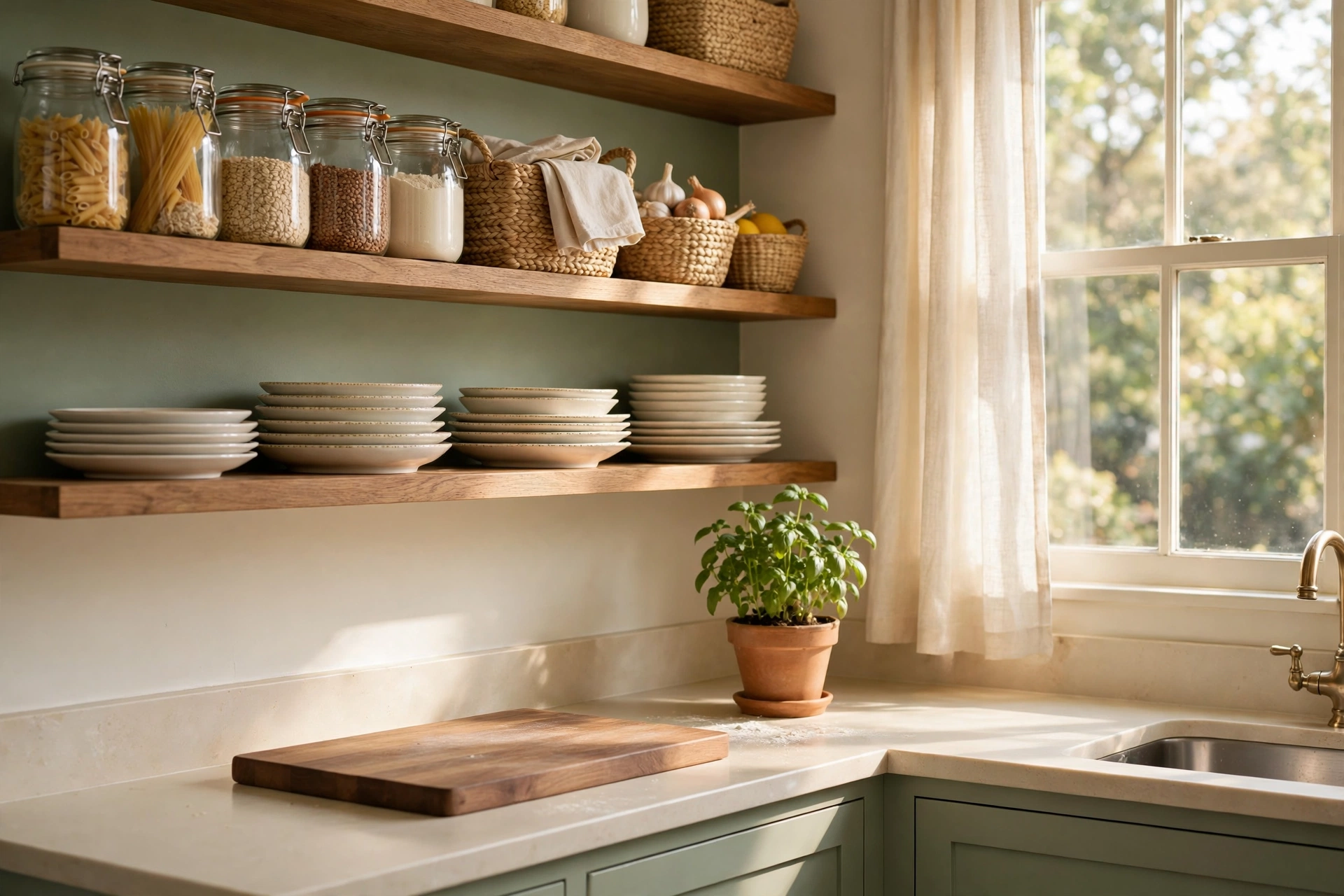
When cabinet space runs out, look up. A wall-mounted rail with S-hooks — the kind you’ll find at IKEA, Target, or Amazon for under $20 — holds your most-used utensils, measuring cups, and even mugs within arm’s reach of the stove. It frees up a whole drawer and looks genuinely good, like the kitchens in the magazines. Hang it on the wall beside the stove or on the side of a cabinet. Keep it to the things you actually use daily so it stays useful instead of becoming wall clutter.
10. Switch to a magnetic knife strip
A knife block takes up a surprising amount of counter space, and a knife drawer is a small hazard every time you reach in. A magnetic knife strip mounted on the wall solves both problems: your knives are visible, easy to grab, and safely out of the way. They’re inexpensive (usually $10 to $20), install with two screws, and free up the counter space the block was hogging. Keep it out of reach of small children, and wipe the strip down once a week so it stays clean.
11. Corral everyday items on a tray
The things you use every single day — olive oil, salt, pepper, the butter dish — tend to spread across the counter and make it look messy even when the kitchen is clean. Put them all on one small tray or a turntable next to the stove. Everything stays in one contained spot, the counter looks intentional instead of cluttered, and wiping down the counter takes ten seconds because you just lift the tray. A simple wooden tray or a small marble board works beautifully and costs very little.
12. Follow the 80% clear counter rule
Here’s the habit that makes the biggest visual difference: keep at least 80% of your counter space clear. That means only the things you use every day earn a permanent spot — usually the coffee maker and the knife strip, maybe the fruit bowl. Everything else lives in a cabinet or drawer and comes out when you need it. Yes, it takes an extra ten seconds to grab the toaster from the cabinet. But a clear counter makes a small kitchen feel twice as big, and it makes cooking and cleaning so much easier that you’ll wonder why you didn’t do it sooner.
Pantry and Fridge Organisation That Actually Sticks
13. Decant dry goods into clear containers
Half-empty bags of flour, rice, and pasta are the enemy of a tidy pantry. Transfer them into clear, airtight containers and three things happen: you can see exactly what you have, the containers stack neatly instead of flopping around, and food stays fresher longer. You don’t need a matching set from a fancy store — any clear containers with lids work, and a set of five costs around $15 to $25 at Walmart or on Amazon. Start with the five things you buy most often and add more as you go.
14. Label everything (even if it feels silly)
Labels feel like overkill until the day someone puts the sugar in the flour container. A roll of masking tape and a marker work perfectly — you don’t need a label maker. Label the containers, label the bins, and label the shelves if your pantry is shared with kids or a partner who “puts things away” in creative places. Labels are what turn a one-time organisation project into a system that actually lasts, because everyone in the house can see where things belong.
15. Zone your fridge like a grocery store
A fridge without zones is just a cold box where leftovers go to die. Divide yours into simple zones: drinks and condiments in the door, dairy and eggs on the top shelf, raw meat on the bottom shelf (where it can’t drip on anything), and produce in the drawers. Add one clear bin for leftovers and one for snacks so nothing gets lost behind the milk. Wipe out one shelf a week when you do the grocery shop, and your fridge will stay organised without a big monthly clean-out.
Frequently Asked Questions
What’s the first thing I should organise in a small kitchen?
Start with decluttering, then tackle the area that frustrates you most — usually the cabinet or drawer you open ten times a day. A quick win in one spot builds momentum for the rest of the kitchen. Don’t try to do the whole kitchen in one afternoon; one zone a day is much more realistic.
How can I organise a small kitchen on a budget?
You can transform a small kitchen for under $50. Shelf risers, turntables, and drawer dividers from Walmart, Target, or the dollar store cover most of what you need. Tension rods make great cheap dividers for pans and lids, and masking tape labels cost almost nothing. The decluttering itself is free and makes the biggest difference of all.
How do I keep my kitchen organised with kids?
Give kids their own low, easy-to-reach spot for their cups, plates, and snacks so they can help themselves (and put things back) without climbing. Use picture labels for younger children who can’t read yet. And accept that “organised with kids” means good systems, not perfection — a kitchen that works is better than a kitchen that photographs well.
What should I get rid of in a small kitchen?
Start with duplicates (you don’t need three spatulas), single-use gadgets you rarely touch, expired food and spices, chipped dishes, and anything you bought for a recipe you made once. If you haven’t used it in a year and it isn’t seasonal, let it go.
The Bottom Line
A small kitchen doesn’t need more space — it needs better systems. Start with decluttering, add a few cheap storage solutions, and build habits that keep things in their place. You don’t have to do all fifteen ideas this weekend. Pick the three that would make the biggest difference in your kitchen, try them this week, and enjoy the feeling of a kitchen that finally works with you instead of against you.
You May Also Like
10 Easy Ways to Save Money on Groceries for Your Family
2 Comments